
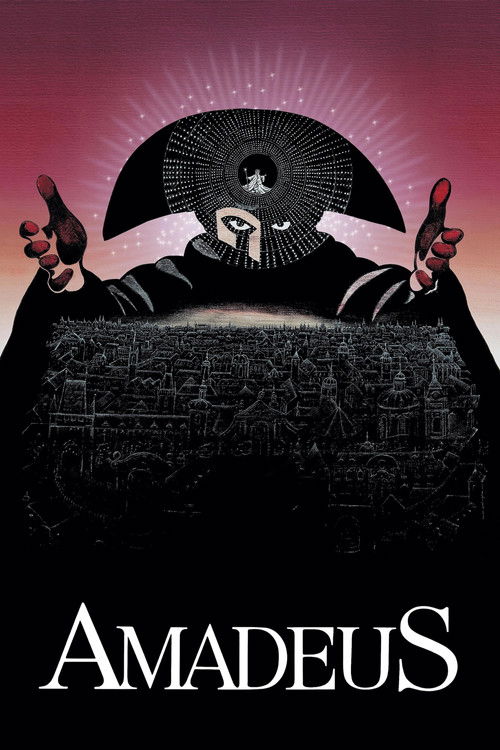
Amadeus (1984)
- Documented locations
- 19
- Year
- 1984
- Directed by
- Miloš Forman
- Cities
- Prague, Kroměříž, Veltrusy, Plzeň, Guermantes, Monte Argentario
Prague, Czechia
Barrandov Film Studios, founded in 1933 on the southern heights of Prague — the largest studios in the Czech Republic. Designed by architect Max Urban, these studios are classified as a cultural monument.
The scene : The studios hosted the interior sets of the film: the Volkstheater, the hospital room, the apartment, and Mozart's staircase.
Prague, Czechia
Neoclassical Theater of Prague (1783), one of the few theaters from the time of Mozart preserved intact. The theater and opera are classified as a national cultural monument, this place embodies the importance of the Prague lyrical repertoire. The hall is operated by the National Theater Company of Prague.
The scene : The theater where Mozart conducts The Marriage of Figaro and Don Giovanni — opera and rehearsal scenes.
Prague, Czechia
Gothic Dominican church of the old town of Prague, with a rich Baroque vault.
The scene : The marriage of Mozart and Constanze.
Prague, Czechia
Baroque palace from 1630 in Malá Strana, with vast Italian-style gardens; today the seat of the Czech Senate. Designed by Andrzej Spezza and Giovanni Pieroni da Galiano, this baroque palace is classified as a cultural monument. Its architecture also draws on mannerism.
The scene : The young Mozart as a child gives a concert in front of the pope; later, he plays for the emperor in the gardens of the palace.
Prague, Czechia
Baroque palace on Malte Square, in Malá Strana, seat of the Grand Priory of the Order of Malta. Designed by architect Carlo Lurago, this baroque palace embodies the Prague baroque style.
The scene : The ball in the manor, and the window of the grand hall from which the injured Salieri is taken into the night.
Prague, Czechia
Palace on Lázeňská Street, in Malá Strana, Prague.
The scene : The staircase where servants bring sweets to Salieri, and where Mozart visits him.
Prague, Czechia
Baroque archiepiscopal palace on Hradčany Square, facing the entrance to Prague Castle. Dating back to 1600, this baroque palace is classified as a national cultural monument.
The scene : The palace of Emperor Joseph II: he commands a new opera from Mozart and deciphers its march on the harpsichord.
Prague, Czechia
Corner house on Kanovnická Street, in the Hradčany district of Prague. Classified as a cultural monument, this house remains an architectural testimony to the historic neighborhood.
The scene : Mozart's house: the maid that Salieri places as a spy, and the composer's returns.
Prague, Czechia
The Invalidovna, a former Baroque hospital-hospice for military veterans (1730s), located in the Karlín district of Prague. Designed by Johann Bernhard Fischer von Erlach, Joseph Emanuel Fischer von Erlach, and Kilian Ignace Dientzenhofer, this national cultural monument embodies the Baroque style of this historic district.
The scene : The courtyard of the asylum where the old Salieri, dying, receives the confession from the young priest.
Prague, Czechia
Porte Léopold, a monumental Baroque entrance of the Vyšehrad fortress, located south of Prague. Designed by the architect Carlo Lurago, it serves as a major entrance to the fortified site.
The scene : Mozart's funeral procession leaves the city through the gate.
Prague, Czechia
Street of Malá Strana, under Prague Castle.
The scene : The street at night where Salieri's cry resonates: "Forgive me, Mozart, for your assassin."
Prague, Czechia
The sloping street of Malá Strana, leading up to Prague Castle. The house located there is classified as a cultural monument.
The scene : The alley through which Mozart returns home after a long night.
Prague, Czechia
Building on Nerudova Street, the cobbled path leading to Prague Castle. Classified as a cultural monument, this building is a significant architectural element of the path.
The scene : The costume rental shop.
Kroměříž, Czechia
Archiepiscopal Palace of Kroměříž (Moravia), a UNESCO-listed Baroque jewel, renowned for its representative rooms and gardens. The complex has served as a residence for the bishops and then archbishops of Olomouc since 1777.
The scene : The ceremony of the Archbishop of Salzburg where Salieri seeks to recognize Mozart, the reprimands of the Archbishop, the masked ball — many Viennese interiors.
Veltrusy, Czechia
Baroque Château de Veltrusy, north of Prague, situated in a large landscaped park by the Elbe River. Designed by architect Giovanni Battista Alliprandi, it is protected as a national cultural monument.
The scene : The aristocratic living room.
Plzeň, Czechia
J. K. Tyl Theatre in Plzeň (Pilsen), a grand Neo-Renaissance theater in Western Bohemia.
The scene : Concert and opera staged.
Prague, Czechia
The scene : The mass grave where Mozart's body is dumped in quicklime, without ceremony — the final scene.
Guermantes, France
Seventeenth-Eighteenth century Château of Guermantes, in Seine-et-Marne, whose name inspired Marcel Proust; today a seminar domain Châteauform'. It is classified as a historical monument by two decrees, in 1944 and then in 1970.
The scene : Period interior sets of the film were shot there.
Monte Argentario, Italy
Passionist convent (Convento della Presentazione al Tempio) on Monte Argentario, a mountainous promontory on the Tuscan coast (Grosseto).
The scene : The flashback of Salieri's Italian childhood, filmed at the Passionist convent.