
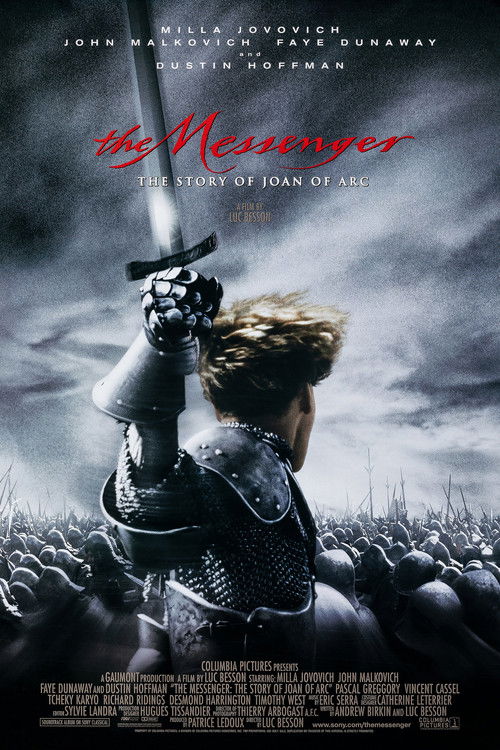
The Messenger: The Story of Joan of Arc (1999)
- Documented locations
- 16
- Year
- 1999
- Directed by
- Luc Besson
- Original title
- Joan of Arc
- Cities
- Pierrefonds, Sées, Gacé, Poitiers, Bruntal, Beynac-et-Cazenac, Biron, Cahors, Epinay-sur-Seine, Sarlat-la-Canéda, Rouen
Pierrefonds, France
The Château de Pierrefonds is an impressive fortress located in Oise, Picardy, at the heart of the commune of Pierrefonds. Built at the end of the 14th century (around 1397) for Louis d'Orléans, brother of King Charles VI, it was designed as a stronghold defending the outskirts of Paris. Dismantled by order of Richelieu after a siege in 1617, it remained in ruins for over two centuries, becoming in the 19th century a 'romantic ruin' much sought after. From 1857, Napoleon III entrusted its restoration to architect Eugène Viollet-le-Duc, who created a very personal reinterpretation of medieval architecture, resembling more of an idealized reconstruction than faithful restoration; the construction was interrupted in 1885, leaving some facilities unfinished. Today, owned by the State and managed by the Centre des monuments nationaux, the building is a major example of neo-medieval architecture and an emblematic testimony to Viollet-le-Duc's vision.
The scene : Filming at Pierrefonds.
Pierrefonds, France
The scene : A few scenes at the Salle des Preuses.
Sées, France
The scene : Shooting at the forecourt of the cathedral.
Gacé, France
Former fortress of Gacé, in Orne, with origins dating back to the 11th century and which underwent successive renovations until the 19th century. The building is listed as a historical monument.
The scene : Filming at the Château de Gacé.
Poitiers, France
The scene : Filming in the Hall of Lost Steps of the Palace of the Dukes of Aquitaine.
Bruntal, Czechia
The scene : Scenes in Orléans and Compiègne.
Bruntal, Czechia
Bruntál Park is a historic garden of about 2.5 hectares arranged around Bruntál Castle, in the Moravian-Silesian Region of the Czech Republic. Established in the 16th century along with the castle, it was equipped in the mid-17th century with an ornamental garden by the Order of the Teutonic Knights, and later transformed into a Baroque garden preserved along the façade, while the rest of the area was designed as an English landscape park. The most significant changes occurred in 1894 at the initiative of Archduke Eugen of Habsburg, based on a plan by Georg von Hauberrisser. The park retains remnants of the old city walls, a bastion, a sala terrena from 1894, as well as about ten sandstone sculptures mostly dating from the turn of the 18th and 19th centuries. A renovation carried out in 2021 added new plantings, sculptures, and an ornamental pond.
The scene : Grandiose sets to recreate Orleans and the fort of the Tourelles bridge.
Beynac-et-Cazenac, France
The fortified castle of the commune of Beynac-et-Cazenac, in Dordogne, whose origins date back to 1200. It is listed as a historic monument.
The scene : The castle hosts two moments: the first meeting of Jeanne with Charles VII, in Chinon, and what the film places in the church of Rouen.
Beynac-et-Cazenac, France
The scene : Filming in Beynac-et-Cazenac.
Biron, France
Biron Castle of the commune of Biron, in Dordogne. It was the seat of a barony considered one of the oldest in Périgord. The building is both classified and listed as a historical monument.
The scene : Filming at the Château de Biron.
Biron, France
The scene : Filming in Biron.
Cahors, France
The scene : Scenes at the Orléans bridge.
Epinay-sur-Seine, France
The Épinay Studios are a complex of film studios located in Épinay-sur-Seine, in Seine-Saint-Denis, and are among the oldest in France. Their origins date back to 1907, when industrialist Charles Jourjon founded the company Éclair, which became the third French firm behind Pathé and Gaumont in the 1910s. The studio itself was set up in 1913 and was then acquired by Éclair in 1914. By the end of the 1920s, the German company Tobis established one of the first sound studios in France at the same address, utilizing the Tobis-Klangfilm process; these neighboring facilities were absorbed by Éclair in 1938. The site long housed film sets and significant development and post-production laboratories, with its studios being taken over by the TSF group in 2009, before the opening of the nearby Cité du cinéma reduced their activity from 2012.
The scene : Filming at the Épinay studios.
Sarlat-la-Canéda, France
The scene : Filming in Sarlat-la-Canéda.
Sarlat-la-Canéda, France
The scene : Several scenes in the narrow alleys.
Rouen, France
The scene : Filming location mentioned.