
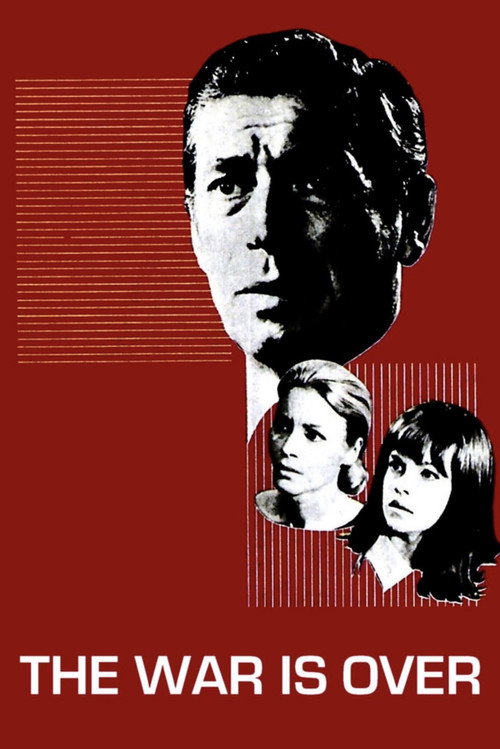
The War Is Over (1966)
- Documented locations
- 32
- Year
- 1966
- Directed by
- Alain RESNAIS
- Original title
- La guerre est finie
- Cities
- Paris, Paris 5e, Ivry-sur-Seine, Paris 12e, Hendaye, Orly, Aubervilliers, Issy-les-Moulineaux, Urrugne, Le Perthus, Ciboure, Stockholm
Paris, France
The scene : Midway through the film, Diego (Yves Montand) walks down Clotilde Street as he takes a long stroll through the streets of the Latin Quarter.
7 rue de l'Estrapade (Paris 5th)
Paris, France
Building constructed in 1725, facing the back of the Lycée Henri-IV which occupies the even numbers 2 to 14 of the street; the rue Laromiguière separates it from number 9.
The scene : Questioned at the border by a policeman who lends him the number 4, Diego (Yves Montand) corrects him: he is supposed to live at 7 rue de l'Estrapade, a borrowed address he has never set foot in. After mistakenly thinking of the wrong building three times, he finally arrives, looks up at the number plate, and enters the stairwell.
Paris, France
The scene : Towards the middle of the film, Diego takes refuge in the lobby of this building, at the corner of rue de l'Estrapade, to observe the passengers of a Peugeot without being seen.
Paris, France
The scene : Emerging from the hallway where he had been hiding, Diego continues on foot down Blainville Street.
Paris, France
The scene : In his abandoned hideout, Diego crosses the Place de la Contrescarpe as he continues his walk through the neighborhood.
Paris, France
The scene : After the episode in the hallway of rue Thouin, Diego's walk also takes him down rue du Cardinal-Lemoine.
2 place de la Contrescarpe (Paris 5e)
Paris, France
Corner café of the place de la Contrescarpe, known under the name La Chope at the time of the film and today under the name Delmas.
The scene : At the beginning of the film, Diego imagines Nadine as several young women, one of whom enters this café to make a phone call. Seventy minutes later, it is he who comes to make a call there, and he sees Nadine (Geneviève Bujold) deep in conversation with a man.
Paris 5e, France
The scene : Diego leaves the café de la Contrescarpe and follows Nadine and the man she was talking to, turning onto rue Mouffetard.
Paris, France
The scene : The couple's surveillance, which began at the exit of the café de la Contrescarpe, then passes through Soufflot Street.
Paris, France
Café de la place Maubert, now under the sign of Village Ronsard.
The scene : This café on Place Maubert is part of the Parisian sets of the film.
9 rue de l'Estrapade (Paris 5e)
Paris, France
Hotel particulier commissioned by the Lyonnais Claude-Philippe Cusset and completed in 1785, built in a U shape around a courtyard. A printing house established there in 1917 and the advertising designer Léo Dupin worked there from 1926; after the war, the coffee manufacturer Brûlerie Saint-Jacques occupied it until the 1970s, before its restoration and conversion into student housing in the 1980s. The façades and roofs have been listed as historical monuments since 1977.
The scene : Every time Diego pictures the building where he is supposed to live, this is the one he sees, with its wrought iron gate and the emblem of the Brûlerie Saint-Jacques. On the train, he even imagines the young woman who lives there coming in, going out, and descending the stairs, before arriving at the right building, at no. 7.
11 Delambre Square (Paris 14th)
Paris, France
The scene : The scenes at Nadine Sallanches' place (Geneviève Bujold) are set in this building on Delambre Square.
Pierre and Marie Curie City (Ivry-sur-Seine)
Ivry-sur-Seine, France
Large housing complex from the late 1950s and early 1960s.
The scene : Diego comes to look for Juan, "building G, tenth floor, number 107, at Madame Lopez's" (Marie Mergey): neither Juan nor she lives there anymore, and Diego wonders if it might have been another housing project. He discovers the area twice, first in his thoughts on the train back to Paris, then actually upon his arrival, through its buildings, shops, and green spaces. In the film, the housing project is supposed to be located in Aubervilliers.
14 quai de Béthune (Paris 4th)
Paris, France
The scene : Centre de gravité du film, c'est l'appartement de Marianne (Ingrid Thulin), la compagne de Diego. Elle y prépare un livre sur la façon dont les villes parlent à leurs habitants, dont Diego feuillette sans intérêt les photographies de panneaux et de flèches peintes au sol. Une nuit, une voiture en part pour la gare de Lyon, un café de l'avenue Daumesnil et un cinéma de la rue de Lyon, avant d'y revenir.
Paris, France
The scene : Learning of Ramon's death, Diego imagines his funeral: the coffin passes through the gate of the Montparnasse cemetery, then the procession gathers in front of the grave. This cemetery comes to his mind because he had seen it shortly before, from the apartment of the young activists that overlooks it, where one of them pointed out to him that he did not seem to like cemeteries.
Paris, France
Neoclassical building designed by Jacques-Germain Soufflot, whose creation dates back to 1758; Jean-Baptiste Rondelet and Maximilien Brébion participated in its construction. Initially a church, it became a mausoleum and is classified as a historical monument.
The scene : The Panthéon is the only Parisian monument shown in the film.
Paris, France
The scene : The Sully Bridge is the only bridge on the Seine that appears in the film.
Paris, France
Porte des Lilas houses a "ghost station" (Porte des Lilas–Cinéma), which is disused and reserved for film and advertisement shoots. It dates back to 1921 and serves as a terminus for the line.
The scene : Diego tells Nadine about a comrade being followed by a policeman in the subway, from Maubert-Mutualité to Raspail with a change at Odéon. The shot illustrating this, a long camera movement where panned shots go from Diego to the activist and then to the policeman, was actually filmed at the Porte des Lilas station, which is not on this route.
Paris 12e, France
Large Parisian train station (12th) with the clock and Train Bleu, a terminal heading southeast. A railway station built in 1847 by Marius Toudoire, it is a listed historical monument. It is the second busiest train station in Paris and also houses an underground station served by the RER.
The scene : During a nighttime car ride starting from the quai de Béthune, the first stop is the Gare de Lyon.
Hendaye, France
The scene : After crossing the border at Béhobie, the camera meticulously follows, from inside the car, the road that leads Diego (Yves Montand) to Hendaye, from where he must catch the train to Paris.
Paris, France
University center built around 1960 on Georges-Bernanos Avenue, in Port-Royal, also referred to as Centre Bullier; it houses the headquarters of the CROUS of Paris.
The scene : The film also showcases modernity in the heart of Paris: this student center of Port-Royal, built around 1960 and referred to by the source as Centre Bullier, contrasts with the old buildings of the Latin Quarter.
Paris, France
The scene : The nighttime driving loop starting from the Béthune quay runs alongside a cinema on Rue de Lyon before returning to Île Saint-Louis.
Paris, France
The scene : During the same night outing, between the Gare de Lyon and Rue de Lyon, the car stops in front of a café on Avenue Daumesnil.
Paris, France
The scene : Another night drive, harder to follow in the darkness, leads from Rue de l'Estrapade to Boulevard Edgar-Quinet.
Orly, France
Second airport of Paris, opened south of the capital in 1961.
The scene : Final sequence: Marianne (Ingrid Thulin) buys a ticket for Barcelona at Orly, where she must warn Diego and Juan to return to Paris. The film ends with her hurrying down a corridor of the terminal, while the face of Diego fades in overlay as he heads towards Spain.
Ivry-sur-Seine, France
Since 1945, the street has been named after Celestino Alfonso, a Spanish Republican captain who was responsible for the Communist Youths of Ivry and was executed by the Germans in 1944.
The scene : Upon his return, the narrator's voice lists the suburbs where Diego's exiled comrades live; the list is illustrated by nine shots of a single street in Ivry, including seven close-ups of posters on a wall, one of which evokes Justo Lopez's appearance before a military court in Madrid. Diego walks down it to meet his communist comrades.
Aubervilliers, France
The scene : Second set for the imagined funeral of Ramon: a small suburban cemetery dominated by social housing towers. Diego sees himself throwing a flower into the grave, then one of the relatives unfolds the Spanish flag in front of the exiles and Ramon's widow.
32 rue Ferdinand-Buisson (Issy-les-Moulineaux)
Issy-les-Moulineaux, France
House that overlooks the cemetery of Issy-les-Moulineaux, which itself was closed from 1961 to 1972.
The scene : Learning of the death of Ramon, his old comrade, Diego imagines him still alive in his garden, then sees his coffin being taken out of the house to be loaded into the hearse.
Urrugne, France
Bridge that crosses the Bidassoa in Béhobie, at the western end of the Franco-Spanish border.
The scene : Opening of the film: on the international bridge spanning the Bidassoa, Diego (Yves Montand) waits and gazes at France spread out before him, Spain behind him, the only view of Spain in the entire film. His driver enumerates what he would have shown him in Madrid, then the car approaches the real French customs post, where a suspicious policeman tries to trap him about his address; a sign indicates Hendaye, Biarritz, Bayonne, and Bordeaux.
Le Perthus, France
Border post at the eastern end of the Franco-Spanish border, near Perpignan, facing Els Límits on the Spanish side.
The scene : At the end of the film, Diego returns to Spain from the other side of the border: two road signs are located by the signs "Le Perthus" and "Le Perthus, border 3 km away," and a customs officer stamps his passport there. The montage links this shot with Marianne at Orly, to the point of leaving the impression that it is her passport.
Ciboure, France
The scene : Final image of the imagined funeral of Ramon: seen from above, a procession of about forty strangers follows a man carrying the Spanish flag, then the camera slowly rises and reveals the sea behind the cemetery wall. This cemetery in Ciboure brings Diego back to the Basque Country, where the film began.
Europa Films Studios (1932–2000s)
Stockholm, Sweden
Studios of the company Europa Film, established in 1932 in an old factory in Mariehäll, Bromma, at the edge of Sundbyberg; all the buildings were demolished in 2008 to make way for housing.
The scene : The interiors of Marianne's apartment and the housing in the Ivry city complex were filmed in sets built in this Swedish studio.