
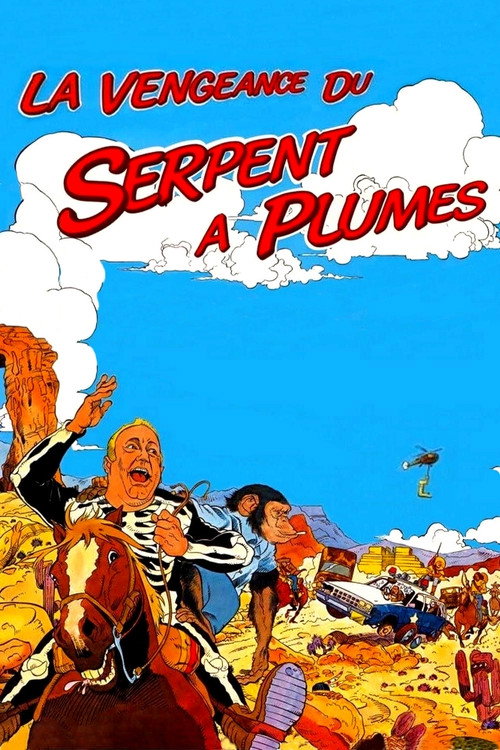
The Vengeance of the Winged Serpent (1984)
- Documented locations
- 17
- Year
- 1984
- Directed by
- Gérard OURY
- Original title
- La Vengeance du serpent à plumes
- Cities
- Chichén Itzá, Izamal, Mexico, Roissy-en-France, Paris 12e, Paris, Paris 19e, Epinay-sur-Seine
France
A vast ski area connected to the Alps (Savoie), one of the largest in the world, including Courchevel, Méribel, and Val Thorens.
The scene : 5 minLoulou Dupin (Coluche) is in charge of a ski lift — and its users.
Roissy-en-France, France
Inaugurated on March 8, 1974, the airport covers 3,257 hectares and six municipalities spread across Val-d'Oise, Seine-Saint-Denis, and Seine-et-Marne. Its Terminal 1, designed by architect Paul Andreu, is a circular building surrounded by seven satellites, nicknamed "the camembert" and labeled 20th-century Heritage.
The scene : 6 minLaura arrives from Mexico; it is also here that a group of agents gets hold of Paco.
Paris 12e, France
Large Parisian train station (12th) with the clock and Train Bleu, a terminal heading southeast. A railway station built in 1847 by Marius Toudoire, it is a listed historical monument. It is the second busiest train station in Paris and also houses an underground station served by the RER.
The scene : 8 minLoulou Dupin (Coluche) is back in Paris.
Paris, France
City Hall of Paris, located in the Place de l'Hôtel-de-Ville, in the 4th arrondissement.
The scene : 9 minReturning to the capital, Loulou Dupin gets into the taxi driven by Jackie.
Paris, France
The scene : 10 minJackie leaves Loulou in front of his house; both cross the porch of the building where an apartment is inherited to him. The scene returns at night, at 34 minutes 14.
Paris 19e, France
The scene : 17 minLoulou Dupin escapes from a blade's strike while descending towards the docks.
Paris, France
Way of the Bois de Boulogne, to the west of Paris, near the polo fields.
The scene : 20 minRatoff and Norbert cross the polo field fence, determined to get their hands on Alix Lefébure.
Paris, France
The scene : 32 minAt night, Laura places an explosive charge against the door of the Lefébure Bank.
Paris, France
The scene : 41 minLoulou Dupin visits Alvaro, who operates a carousel, and unknowingly leaves with Lucien, the monkey, in his taxi.
Paris, France
Former luxury ephemeral hotel of the Champs-Élysées district, François-Ier street, opened in the early 1980s.
The scene : 44 minThe luxury hotel where Loulou and Laura are staying; Valérie drops off Laura there (night scene).
Paris, France
The scene : 44 minValérie rides Laura on a motorcycle in the street.
Izamal, Mexico
Grand Franciscan convent of the 16th century in Izamal, renowned for its immense arched atrium, one of the largest in the world.
The scene : 1 hr 5 minA party is taking place at night at the foot of the monument. Around 25 minutes in, Loulou Dupin spots Ratoff who rushes into the building — including the atrium and the altarpiece.
Izamal, Mexico
Central square of Izamal, the "yellow city" of Yucatán with ochre colonial buildings.
The scene : 1 hr 14 minA police convoy, flanked by two motorcycles, crosses the urban area.
Chichén Itzá, Mexico
Great Maya-Toltec city of Yucatán, dominated by the pyramid of Kukulcán, listed as a UNESCO World Heritage site.
The scene : The very first images, at sunrise, before the credits: Paco and Laura make a too-curious photographer disappear. The setting returns at night, at 1:24.
Mexico, Mexico
Great movie studio in Mexico, located in Coyoacán, one of the most important in Latin America. Established in 1945, it is also a concert hall.
The scene : Some interiors of the film were shot in these Mexican studios.
Mexico
Gulf of Mexico arms bordering the coasts of Yucatán, Campeche, Tabasco, and Veracruz.
The scene : The final scene, featuring the Alouette III helicopter, takes place over the gulf.
Epinay-sur-Seine, France
The Épinay Studios are a complex of film studios located in Épinay-sur-Seine, in Seine-Saint-Denis, and are among the oldest in France. Their origins date back to 1907, when industrialist Charles Jourjon founded the company Éclair, which became the third French firm behind Pathé and Gaumont in the 1910s. The studio itself was set up in 1913 and was then acquired by Éclair in 1914. By the end of the 1920s, the German company Tobis established one of the first sound studios in France at the same address, utilizing the Tobis-Klangfilm process; these neighboring facilities were absorbed by Éclair in 1938. The site long housed film sets and significant development and post-production laboratories, with its studios being taken over by the TSF group in 2009, before the opening of the nearby Cité du cinéma reduced their activity from 2012.
The scene : Some interiors of the film were shot in these studios.