
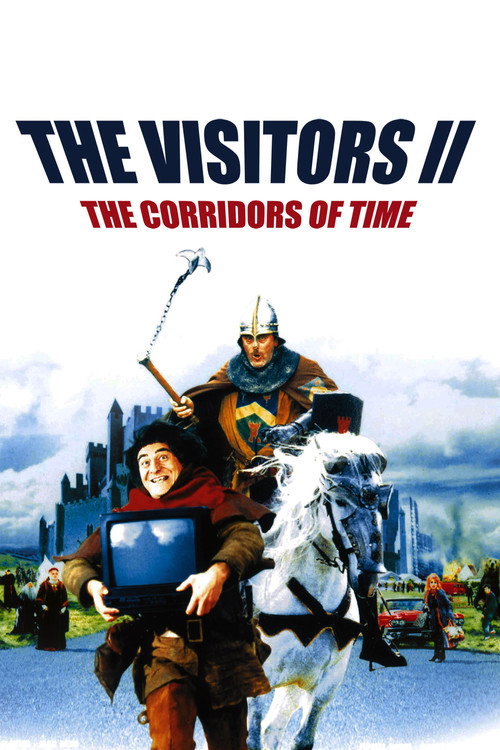
The Visitors II: The Corridors of Time (1998)
- Documented locations
- 18
- Year
- 1998
- Directed by
- Jean-Marie Poiré
- Original title
- Les Couloirs du temps : Les Visiteurs II
- Cities
- Beynac-et-Cazenac, Biron, Villiers-le-Bel, Luzarches, Neauphle-le-Château, Rambouillet, La Roche-Guyon, Magny-en-Vexin, La Ferté-Milon, Saint-Jean-les-deux-Jumeaux, Pierrefonds, Maincy, Saint-Hilarion, Ermenonville, Mont-l'Évêque, Bleury-Saint-Symphorien, Perthes, Epinay-sur-Seine
Beynac-et-Cazenac, France
The fortified castle of the commune of Beynac-et-Cazenac, in Dordogne, whose origins date back to 1200. It is listed as a historic monument.
The scene : Medieval castle serving as the backdrop for the castle of Montmirail.
Biron, France
Biron Castle of the commune of Biron, in Dordogne. It was the seat of a barony considered one of the oldest in Périgord. The building is both classified and listed as a historical monument.
Villiers-le-Bel, France
Luzarches, France
The scene : Godefroy de Montmirail and Jacquouille, just disguised as gendarmes, climb the cobblestones and are hailed by a mother of a family.
Neauphle-le-Château, France
The scene : Scene with Godefroy the Hardy (Jean Reno) in a cobblestone street.
Rambouillet, France
The scene : Scene in front of the municipal credit.
La Roche-Guyon, France
The scene : Godefroy takes a seat for the first time in a "devil's chariot," then leans his head outside, lacking air.
Magny-en-Vexin, France
The scene : Godefroy le Hardi and Jacquouille, now dressed as gendarmes, climb the cobblestones after having shouted to a teenager: "do your duty little man."
La Ferté-Milon, France
The scene : Scenes of visitors in the supermarket.
Saint-Jean-les-deux-Jumeaux, France
The scene : Out of fuel, Jacquouille and Ginette abandon the vehicle and walk up a small road, jerrycan in hand.
Pierrefonds, France
The Château de Pierrefonds is an impressive fortress located in Oise, Picardy, at the heart of the commune of Pierrefonds. Built at the end of the 14th century (around 1397) for Louis d'Orléans, brother of King Charles VI, it was designed as a stronghold defending the outskirts of Paris. Dismantled by order of Richelieu after a siege in 1617, it remained in ruins for over two centuries, becoming in the 19th century a 'romantic ruin' much sought after. From 1857, Napoleon III entrusted its restoration to architect Eugène Viollet-le-Duc, who created a very personal reinterpretation of medieval architecture, resembling more of an idealized reconstruction than faithful restoration; the construction was interrupted in 1885, leaving some facilities unfinished. Today, owned by the State and managed by the Centre des monuments nationaux, the building is a major example of neo-medieval architecture and an emblematic testimony to Viollet-le-Duc's vision.
Maincy, France
Baroque castle from the 17th century built for Nicolas Fouquet by Le Vau, Le Brun, and Le Nôtre; its splendor directly inspired the construction of Versailles.
Saint-Hilarion, France
Neoclassical style castle built at the end of the 19th century in Saint-Hilarion, in the Yvelines, surrounded by a large park. Designed by architect René Sergent, assisted by landscape architect Achille Duchêne, it is listed as a historic monument.
The scene : Interior scenes at the Duke of Luigny’s castle (Philippe Béglia).
Ermenonville, France
Mont-l'Évêque, France
Bleury-Saint-Symphorien, France
The estate is now operated as a luxury hotel.
The scene : The residence attributed to Valéry de Luigny, which Cora shares with him.
Perthes, France
The scene : Scene in the "Garage Pochard" with Jacquouille (Christian Clavier) and Béatrice (Muriel Robin).
Epinay-sur-Seine, France
The Épinay Studios are a complex of film studios located in Épinay-sur-Seine, in Seine-Saint-Denis, and are among the oldest in France. Their origins date back to 1907, when industrialist Charles Jourjon founded the company Éclair, which became the third French firm behind Pathé and Gaumont in the 1910s. The studio itself was set up in 1913 and was then acquired by Éclair in 1914. By the end of the 1920s, the German company Tobis established one of the first sound studios in France at the same address, utilizing the Tobis-Klangfilm process; these neighboring facilities were absorbed by Éclair in 1938. The site long housed film sets and significant development and post-production laboratories, with its studios being taken over by the TSF group in 2009, before the opening of the nearby Cité du cinéma reduced their activity from 2012.
The scene : Studio decor (indoor shooting).