
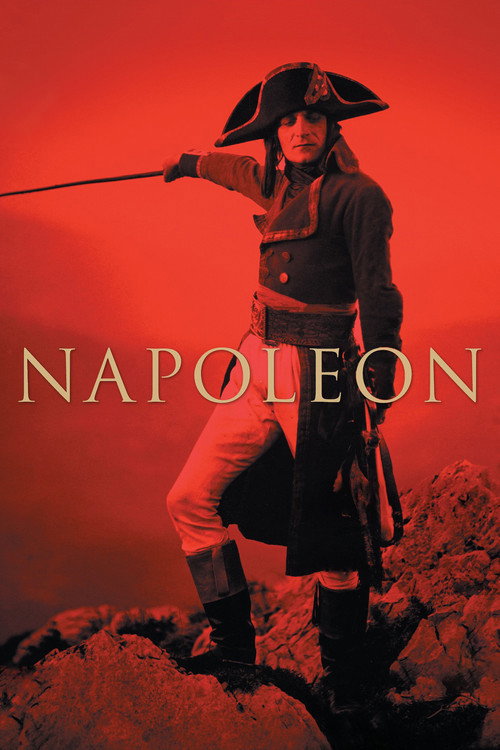
Napoleon (1927)
- Documented locations
- 21
- Year
- 1927
- Directed by
- Abel GANCE
- Original title
- Napoléon
- Cities
- Ajaccio, Grosseto-Prugna, Antibes, La Seyne-sur-Mer, Toulon, Solliès-Ville, La Garde, Briançon, Montgenèvre, Cauterets, Sceaux, Versailles, Paris, Boulogne-Billancourt
Ajaccio, France
The scene : The Paolists assault the Bonaparte family's country house, on the heights of Ajaccio.
Grosseto-Prugna, France
The scene : It is from the plain bordering the Genoese tower of Capitello that Bonaparte, hunted down, takes to the sea and leaves Corsica.
Ajaccio, France
The scene : Bonaparte retreats to the Casone cave, overlooking the city.
Ajaccio, France
The scene : Facing the open sea, Bonaparte gazes at the water from the cape that overlooks the Sanguinaires Islands.
Ajaccio, France
The scene : The Bonaparte family home, located in the heart of Ajaccio, plays its own role on screen.
Antibes, France
The scene : Bonaparte is imprisoned in the star-shaped fortress that guards the entrance to the port.
La Seyne-sur-Mer, France
The scene : The battles of the Siege of Toulon revolve around the fort that locks the small harbor.
Toulon, France
The scene : The inn scenes of the Siege of Toulon are filmed in the city, with no address provided by IMDb.
Solliès-Ville, France
The scene : The estate serves as the exterior of the Beauharnais castle: this is where Bonaparte leaves Joséphine.
La Garde, France
The scene : Two pieces of the Italian countryside are filmed in the municipality: the Battle of Montenotte, followed by Bonaparte's junction with the army in Albenga, shot in a quarry and presented in a triple screen. The quarry is that of the andesite rock from the old village, exploited in the late 19th century for the pavements of Toulon and since abandoned.
La Garde, France
Romanesque church from the 12th century that crowns the andesite rock of the old village, modified in 1480. The rock, an ancient volcanic dyke exposed by erosion, served as a quarry after the Revolution: cobblestones from it were extracted for Toulon at the end of the 19th century.
The scene : The filming takes place at the foot of the chapel overlooking the old perched village.
Briançon, France
The scene : Below the ramparts of the Vauban citadel, the north gate serves as a schoolyard: it is here that the snowball fight of Brienne takes place.
Montgenèvre, France
The scene : Film France lists Montgenèvre among the filming municipalities, without specifying what was filmed there.
Cauterets, France
The scene : IMDb places some of the shots in the surroundings of Cauterets, without going further than the name of the valley.
Sceaux, France
The scene : The Orangerie of the estate houses the scenes of 18 Brumaire.
Versailles, France
Former residence of the kings of France in Versailles, a masterpiece of French classicism, now a museum and a UNESCO World Heritage site. The work initiated in 1661 involved Louis Le Vau, Jules Hardouin-Mansart, and André Le Nôtre.
The scene : Abel Gance set up his cameras at the castle, which Télé Star ranks among the locations of this over seven-hour fresco.
Versailles, France
Small neoclassical chateau built for Louis XV in the park of Versailles, given by Louis XVI to Marie Antoinette who made it her private estate. It was designed by the architect Ange-Jacques Gabriel and is listed as a historical monument.
The scene : The small castle of Marie Antoinette is among the locations available to the crew on the estate.
Versailles, France
The scene : The pink marble palace also hosts the shooting, which the press mentions without detailing the shots that were taken there.
Paris, France
The scene : IMDb, along with the press, cites Paris as one of the filming locations, without ever descending to the address.
Boulogne-Billancourt, France
Boulogne-Billancourt film studios, located on the Quai du Point-du-Jour. Founded in 1922 under the name Studio-usine Eclipse, they became Paris-Studios-Cinéma in 1926 and then Billancourt Studios in 1933. Closed in 1992, they were demolished in 1995.
The scene : IMDb designates the Billancourt complex, then operated under the name Paris Studios Cinéma, as the film's studio, without specifying which interiors were set up there.
Boulogne-Billancourt, France
Canal Factory, formerly known as the Studios de Boulogne, is a complex of filming studios located in Boulogne-Billancourt, between Avenue Jean-Baptiste-Clément and Rue de Silly, and is one of the historic landmarks of French cinema. Founded in 1941 and long operated by the Société française de production (SFP), it has hosted countless film and television shoots. Acquired by the Canal+ group, it was renovated and renamed "Canal Factory" in 2016. The site now includes five filming stages and remains an active production complex.
The scene : L2TC connects the studio shots to the sets on rue de Silly, in Boulogne — a connection that the source weakens by dating these studios to 1941, fifteen years after the filming.