
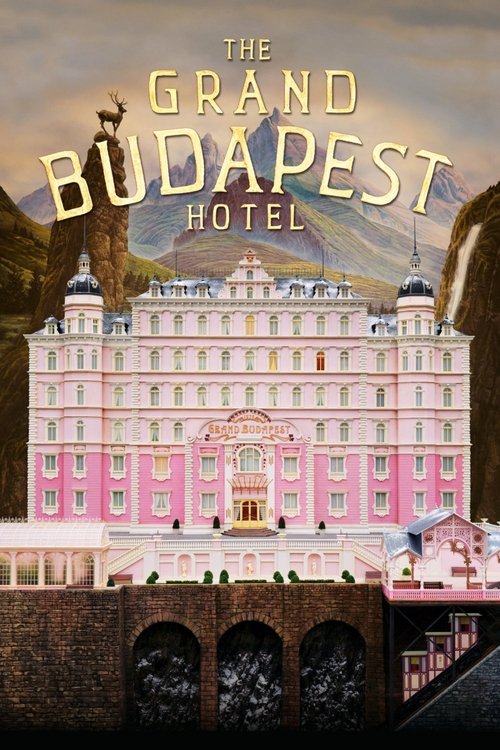
The Grand Budapest Hotel (2014)
- Documented locations
- 18
- Year
- 2014
- Directed by
- Wes Anderson
- Cities
- Görlitz, Dresde, Hainewalde, Waldenburg, Zwickau, Kriebstein, Lohmen, Potsdam, Cracovie
Görlitz, Germany
Art Nouveau department store built in the center of Görlitz in the early 1910s, remained in operation until the late 2000s and has been vacant since.
The scene : The entire interior of the palace is here: it is in the atrium and the stairs of this abandoned department store that Zero begins his journey as a bellboy, under the watchful eye of the concierge Gustave H. Two lobby sets have been created within the same space, one for the golden age of the 1930s, the other for the decline of the 1960s, when the old Zero receives the young writer.
Görlitz, Germany
Concert and performance hall built in 1910 according to the plans of architect Bernhard Sehring, located on the edge of the municipal park of Görlitz. In neoclassical style, it is classified as a historical monument of Saxony.
The scene : Three sets in a single building. The auditorium becomes the vast restaurant of the hotel, where the old Zero recounts to the writer his friendship with Gustave; it also serves as a trophy room when the notary Kovacs reads Madame D.'s contested will in front of the heirs, and then as the museum's armory where this same Kovacs tries to escape from Jopling.
Görlitz, Germany
Public baths of Görlitz built in 1887, now disused.
The scene : Under the vaults of these abandoned public baths, the young writer approaches Zero Moustafa for the first time: the conversation that sparks the entire narrative unfolds in the steam of the hotel's thermal establishment.
Görlitz, Germany
The scene : Disguised as monks, Gustave and Zero slip into the monastery to find Serge X., the butler whose testimony could overturn everything.
Görlitz, Germany
The scene : It is in this street that Zero reads the newspaper and comes across the news that changes the plot: Madame D. is dead.
Görlitz, Germany
The scene : The pedestrian street and its kiosk: Zero picks up the morning newspapers there, a mundane gesture by which the second chapter of the film begins.
Görlitz, Germany
The scene : The front of the Mendl's bakery occupies one of those facades of the old town, with the bell tower of the Dreifaltigkeitskirche in the background; Agatha comes out carrying her boxes of cakes.
Görlitz, Germany
The scene : A teenage girl comes to read in front of the Author's grave: it is through this cemetery that the film opens, and it is there that it concludes.
Dresde, Germany
Dresden creamery opened in 1892, famous for its interior entirely covered with hand-painted ceramic tiles, to the point of being regarded as the most beautiful creamery in the world.
The scene : The interior of Mendl's pastry shop, where Agatha shapes the famous chocolate courtiers, is this Dresden creamery whose walls disappear under painted tiles.
Dresde, Germany
Baroque palace built starting in 1711 according to the plans of Matthäus Daniel Pöppelmann and complemented by an orangery, to host the celebrations of the Saxon court. Almost completely destroyed during World War II and then rebuilt, this historical monument of Saxony now houses a collection of museums, including the gallery of Old Masters and the Dresden porcelain collection.
The scene : The Zubrowka Art Museum is this palace: Kovacs descends from the cable car and rushes inside to shake off the man who is following him.
Dresde, Germany
Dresden Art Museum with a collection that dates back to 1560, located in the Zwinger wing built by the architect Gottfried Semper.
The scene : The chase tightens in the old painting gallery, where Jopling is tracking notary Kovacs.
Hainewalde, Germany
18th-century castle built on the banks of the Mandau River in Saxony. Occupied as early as 1933 by Nazi assault sections, which established a temporary concentration camp for political prisoners, it became a private residence again after the war, and was left vacant from 1972; an association has been working since 2000 for its preservation.
The scene : Madame D.'s residence, seen from the outside, is the castle by the Mandau River, where Gustave and young Zero arrive to pay their respects after the old lady's death.
Waldenburg, Germany
Castle founded in the second half of the 12th century, destroyed and rebuilt several times over the centuries. It housed a healthcare facility from 1948 to 1998, before being restored starting in 2005 to its state from 1912; it now hosts guided tours, concerts, and weddings.
The scene : The interiors of Madame D.'s residence were filmed here: Gustave comes to bow before the deceased in the grand blue salon, and it is in the library that he and Zero contemplate the Boy with the Apple, the painting she bequeathed to him.
Zwickau, Germany
A 13th century fortification ravaged by a fire in 1403, restored in 1590 as a Renaissance castle. It served as a prison from the 18th century until the end of World War II, with Karl May and Rosa Luxemburg among its detainees, and later as a political prison until the German reunification. The building now houses a retirement home.
The scene : Accused of murdering Madame D., Gustave is locked up in the internment camp Checkpoint 19: the corridors and the cells where he serves his sentence are those of this former prison.
Kriebstein, Germany
Castle perched on a cliff overlooking the river, in Saxony.
The scene : Seen from the outside, Checkpoint 19 camp is this castle clinging to its cliff above the river: the fortress from which Gustave and his accomplices escape.
Lohmen, Germany
Footbridge of the sandstone massif of Saxon Switzerland. A first wooden bridge was thrown there in 1826 over a narrow ravine to provide access to views of the rocks and the Elbe; the current sandstone structure dates from around 1851.
The scene : Zero and Agatha marry on the panoramic platform hanging over the sandstone cliffs, with the bridge and the void of the valley as their only decoration.
Potsdam, Germany
The oldest large film studio complex in the world, founded in 1912 in Potsdam, the cradle of German cinema (Metropolis, The Blue Angel).
The scene : The pink palace in the shape of a wedding cake and its funicular never existed in reality: the models used for all the wide shots of the hotel were made in these studios, where part of the Zubrowka sets were also constructed.
Cracovie, Poland
The scene : Views of the city serve as a backdrop to the cemetery where the young reader comes to pay her respects: the set itself was built in Görlitz.