
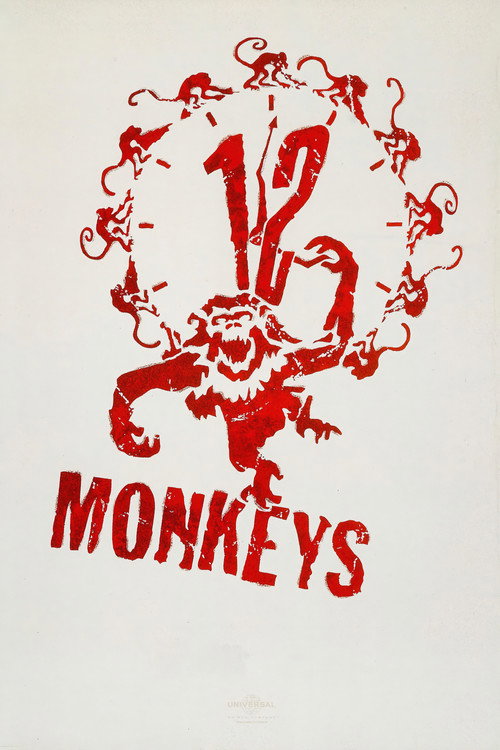
Twelve Monkeys (1995)
- Documented locations
- 28
- Year
- 1995
- Directed by
- Terry Gilliam
- Cities
- Philadelphie, Camden, Baltimore, Lutherville, Upperco, Montréal
Philadelphie, United States
Former Philadelphia penitentiary (1829-1971), the world's first "modern" penitentiary with cell isolation, now a museum and classified Gothic ruin.
The scene : The interiors of the psychiatric asylum from 1990 were filmed in the old penitentiary.
Philadelphie, United States
Philadelphia Academy founded in 1848, recognizable by its large neoclassical building, Founder's Hall.
The scene : The establishment served as the setting for the film.
Philadelphie, United States
Historic department store in Philadelphia (now Macy's), famous for its grand organ and atrium. It is designated a National Historic Landmark and listed on the National Register of Historic Places.
The scene : Cole and Railly are shopping for clothes and wigs.
Philadelphie, United States
Building under the elevated subway of Kensington Avenue, in the northeast of Philadelphia.
The scene : The headquarters of the Army of the Twelve Monkeys.
Philadelphie, United States
Historic stadium of the University of Pennsylvania, one of the oldest in the United States (1895). It was designed by Frank Miles Day. It was built to host the first Penn Relays and is considered the first venue equipped with a functioning scoreboard and stacked stands.
The scene : The stadium served as a backdrop for the film.
Philadelphie, United States
Philadelphia City Hall, a massive Second Empire building topped by a statue of William Penn, was once the tallest building in the city.
The scene : The inner courtyard and the surroundings of the city hall depict post-apocalyptic Philadelphia where Cole ventures.
Philadelphie, United States
Monumental former coal power plant on the banks of the Delaware, located in Philadelphia, designed by John T. Windrim.
The scene : The old power plant represents the underground prison of the post-apocalyptic future.
Philadelphie, United States
Former power plant on the banks of the Delaware in Philadelphia. Built in the Beaux-Arts style and listed on the National Register, it operated as a gas and oil turbine power plant.
The scene : This other power plant on the banks of the Delaware served as a backdrop for the film.
Philadelphie, United States
Fairmount Park's Palace of Fine Arts, a remnant of the 1876 World’s Fair in Philadelphia. It is a museum designated as a National Historic Landmark and listed on the National Register of Historic Places. Since 2008, it has hosted the Please Touch Museum, after having housed the Pennsylvania Museum of Art and its school of industrial arts.
The scene : Kathryn Railly is kidnapped after her lecture on the Apocalypse.
Philadelphie, United States
Former building of the Ridgway Library (Library Company of Philadelphia), an imposing Greek temple on South Broad Street, now occupied by the Philadelphia High School for Creative and Performing Arts (CAPA).
The scene : Cole and Railly hide from the police.
Philadelphie, United States
Philadelphia's grand convention center, which occupies the former Reading Terminal. Designed by George Howe and William Lescaze in the International style, it is designated a National Historic Landmark, listed on the National Register, and marked as a Pennsylvania state historical marker.
The scene : The interiors of the airport scenes (the finale) were filmed at the convention center.
Philadelphie, United States
Eating disorder treatment center, located in a wooded area in the northwest of Philadelphia.
The scene : This center served as a setting for the film.
Philadelphie, United States
The oldest zoo in the United States, opened in 1874, located in Fairmount Park (Philadelphia).
The scene : The activists free the animals from the zoo.
Philadelphie, United States
Former Metropolitan Opera House on North Broad Street, a large hall from 1908 that has long been left abandoned. Designed by architect William H. McElfatrick in Neoclassical architecture, it is listed on the National Register of Historic Places.
The scene : The abandoned theater served as the backdrop for a scene.
Philadelphie, United States
Higher education institution of Spring Garden, in Philadelphia.
The scene : The exterior features the police station that Kathryn Railly leaves after her abduction, as seen on television.
Camden, United States
Industrial city of New Jersey, on the east bank of the Delaware facing Philadelphia.
The scene : Scenes were filmed in Camden, facing Philadelphia.
Baltimore, United States
The largest private mansion of the 19th century in Baltimore, located on Mount Vernon Place, created by Stanford White.
The scene : The interiors of Dr. Goines's residence.
Lutherville, United States
Tudor-style manor from Baltimore County, built in the 1930s with medieval elements imported from Europe. It is listed on the National Register of Historic Places.
The scene : The exteriors of Dr. Goines' residence.
Baltimore, United States
Former Kernan Hotel of Baltimore, on West Franklin Street. It is listed on the National Register of Historic Places and features Neo-Renaissance architecture.
The scene : Under the name "Globe Hotel", Railly and Cole take a room for an hour.
Baltimore, United States
Baltimore Museum of Art with vast collections, from Antiquity to Art Nouveau, located on Mount Vernon Place. It was established in 1934 by architect William Adams Delano. Its holdings are those of a private art collection made accessible to the public.
The scene : The character of Kathryn Railly is introduced in the Renaissance painting gallery.
Baltimore, United States
Jonestown Street, in the northeast of Baltimore. The historic area is listed on the National Register of Historic Places and features Neo-Renaissance architecture.
The scene : The scene of the police van.
Baltimore, United States
Former power station of Westport, on the banks of the Patapsco south of Baltimore.
The scene : The interrogation scene was filmed in the basement of turbine number 4 at the Westport power plant.
Baltimore, United States
Art Deco Cinema from 1939 in Baltimore, a single-screen venue classified. It was designed by architect John Jacob Zink and is listed on the National Register of Historic Places.
The scene : The Hitchcock festival takes place in this cinema.
Baltimore, United States
Main airport of the Baltimore area in Maryland. Opened in 1947, it is an international airport receiving regular commercial traffic. Officially named Thurgood Marshall International Airport, it is located in Linthicum and also serves Washington.
The scene : The airport served as the backdrop for the climax scenes.
Upperco, United States
Rural community in the northern part of Baltimore County, in Maryland.
The scene : The scene at the gas station (at the corner of Falls Road and Mt Carmel Road) where Cole and Railly stop.
Montréal, Canada
The scene : Scenes were filmed in Montreal, around Robert-Bourassa Boulevard, in the Quartier des Spectacles.
Philadelphie, United States
Grand neoclassical art museum of Philadelphia (1928), at the top of Benjamin Franklin Parkway; its monumental staircase has become iconic thanks to Rocky. The building features Greek Revival and Art Deco styles, designed by architects Horace Trumbauer, Julian Abele, Paul Philippe Cret, and the firm Zantzinger, Borie & Medary.
The scene : An escaped tiger prowls the deserted streets at the foot of the grand staircase of the museum.
Baltimore, United States
The scene : The police station from which Cole is transferred to the psychiatric asylum.